Tag Archive for: Yoga

Visual representation of repetition in meditation

First, a word of thanks to all of those who extended their good wishes, food, and prayers after I broke my leg some three weeks ago.  I’m happy to say that the force of healing is alive within me and I make noticeable progress each day. In part, I attribute this healing to repetition in meditation.

As an offshoot of that healing process, I started to offer a free, online meditation course on Wednesday and Friday mornings, 7:30-8:10am. The class consists of a brief asana practice, opening mantra, followed by pranayama, then meditation proper, and a closing mantra. Admittedly, it starts abruptly to ensure we cover these synergistic practices. We don’t discuss theory so much as, well, just get started.

So, I want to give a little context and share one simple idea underlying our practice.  That is simply this, “repetition in meditation”. Repetition is integral to any discipline; whether it be learning the violin, fostering a loving relationship, or advancing spiritual growth. The journey of 1,000 begins with the first step.  And then the next step. And then the next step…. repetition.

There is a fairly well-known expression within meditation circles:

“Better to dig one deep well than many shallow holes.”

For this reason, the repetition in meditation technique I present remains the same for the remainder of the series. My hope is that we get enough of a footing on the method that it becomes a part of us – to give it a fair chance to positively shape the way we view ourselves and our world.

Adopting a single technique for forty days is a common benchmark to get acquainted with a technique.  After those forty days of repeated practice, you can adequately assess if you wish to continue, or not.  There is an overwhelming chance that you will see the benefit and want to continue, you will have seen the value of repetition in meditation.

At the same time, we live in a culture obsessed with variety, innovation, and distraction (largely for commercial purposes). Methodical repetition is antithetical to the pace of modern life (though that seems to be on hold for the moment). However, to develop mastery, or better yet, to develop mastery of your mind, body, and character it takes more than one try. With persistent effort, you will discover the benefit.  The meditation class is here to support you to develop that skill. Of course, I’d encourage you to practice outside of class as well.

“The beginner has many options, the master very few.”

The beginner has many options, the master very few.  As you develop your meditation practice, I invite you to embrace repetition.  Through repetition in meditation, gradually clear away the dust and grime that obscures the inner-mirror. This inner-mirror aids you to see yourself more clearly, to dismantle fear and anxiety and reflect greater peace and joy back upon you.  But it doesn’t all happen by itself, it requires repetition.

Dates & Times:

  • Present through May 1st, 2020
    (May extend depending on interest)
  • Wednesdays and Fridays, 7:30-8:10am.
  • Online Zoom entry-link provided with registration

= Free of Charge =
ADDITIONAL DETAILS HERE

Trust this finds you safe and perhaps even able to adapt to current circumstances.  In either case, it’s times like these that force us to reframe our assumptions of “normal”,  reconsider where we derive security, and reflect on our yoga practice.

Personally, meditation has always been my go-to safe-space.  I can practice at any time, regardless of outer circumstances, and find refuge. It is a friend in times of plenty and in times of need.

On March 23rd, on the eve of the stay at home order, I slammed into the concrete in a bike crash and broke my left femur bone.  Assessing the damage, getting to the hospital, going into surgery… it all felt so surreal and beyond my control. This is not happening to me?  

Then the emotions came.  At first, I held the warrior’s edge to deal with the pain and work with the medical teams.   Which gave way to grief once the initial trauma subsided and I was alone in my hospital bed at 3am.  Slow warm tears and a sense of loss.

It’s been a journey of reckoning. Throughout that journey, meditation has been my throughline, the port in the storm, my guiding compass and light. Bedridden, through the powers of meditation, I began to put my fragile self back together and ignite the flame of healing.

Adversity brings out many things in people, and in my case, it’s inspired me to share what I know and love best with you.  Meditation.  Current events make this offer even more pertinent. I hope we can all find a way to give our gifts in a time of need.

All are freely welcome. Come and reflect on our yoga practice.

Hatha Yoga Meditation Class Format:
The 35-minute class will look like this:

  • Introduction
  • Candle lighting and mantra invocation (Mahamritunjaya mantra for personal and collective healing) 
  • Dedicated pranayama practice
  • Guided meditation
  • Closing mantra (Shantipath for peace)

Taught from the serenity of my ‘yoga basement’ this class will emphasize direct practice of tantric hatha yoga meditation, more so than theory or explanation.  I will provide supplemental links and resources so you can continue the practice outside of our sessions.

Yours in Peace,

Signature of the lead teacher for the Denver Yoga Underground.


Integrated yoga Postures

Integrated yoga postures do not happen on their own.  An astute yoga teacher goes beyond a route understanding of poses or scripped sequences.  More than likely, they understand anatomy and physiology and how all the components of the body fit together.

This allows them to intelligently sequence their yoga classes such that one posture seamlessly unfolds into and complements the next.  As a metaphor, it is a little like seeing the underlying patterns that solve a Rubik’s Cube. The novice will hopelessly turn the thing over and over, daunted by the interwoven puzzle.

“Oh, I think I got it!” Is soon followed by by “C^@&,
I messed up the other side!”

As any beginning yoga student can attest, the poses initially appear unattainable.  However, with practice, one learns how to lovingly work with the inherent structure of the body and encourage it to gracefully open to create integrated yoga postures.  At first, the green side of the cube may start to emerge. Eventually, the other sides of the start to open.  Red, yellow, blue, white and orange begin to gradually follow suit.

To skillfully solve the puzzle it helps to understand how all the colors relate to one another, to learn what postures feed into other postures. This process is a journey of trial, error and discovery.  With time, one learns how to create integrated yoga postures that are much greater than the sum of their parts. 

Sometimes you need a more blue practice that features forward folds, other times you need a fiery red practice that emphasizes back bends.  Or perhaps you need a yellow practice to brighten your day. Some understanding of anatomy will give you the tools to work with the body and safely approach more and more advanced postures that suit your particular needs, whatever color that may be.

“This is the beauty of yoga practice…”

In part, this is the beauty of yoga practice. It is an ongoing process of self discovery.  One gets to explore how the different parts of their body are interwoven with one another and how to bring these components together into one seamless expression. All the colors align to foster ultimate wellbeing.  

This is my final letter of 2019 to share with you a commitment for 2020. I continue to expand the reach of my offerings and want to make yoga training available for everyone. As you know, yoga is beneficial in so many ways and it only seems reasonable to share it generously.

Yogis practicing yoga nidra

Yoga, as a traditional practice, is the skillful and earnest exploration of the personal and transpersonal human experience. Yoga as a practice of personal discipline and self-inquiry is and will always be “free” to explore, and the teachings are readily available in publications and on the internet. All of us long for peace on the deepest level.

And while weekend immersions and retreats are powerfully transformative,
not everyone can access or afford it.

I’m very excited to announce that my first two primary Colorado offerings in 2020 will be offered on either be donation or Pay What You Can basis.  I will teach my yoga nidra training collaboration with Axis Yoga/The Yoga Underground, and Erik Vienneau the founder of Awake, both of whom share a commitment to accessibility.  I list the events here in short form:

  • Pay-What-You-Can Yoga Nidra Immersion at Axis Yoga/The Yoga Underground Jan 31-Feb 2nd
  • Awake Meditation 1-Day Retreat, by donation, at The Gathering in Evergreen Feb 9th

Please spread the word, particularly to those typically may not be able to afford more advanced training.  There is limited at these events and early registration is recommended.

For complete details on these and many other offerings please visit my website.

I hope this holiday season brings you heart-felt connections with loved ones. And we can share in a desire to make yoga training available to everyone.

– Jeremy Wolf

How Do I Develop a Home Practice?

In an age of unprecedented amounts of distractions, it’s no wonder that so many people struggle with having a regular home practice.

How to start?  Ideally you receive instruction from a qualified teacher who gives a specific method and guidance based on your particular psycho-physiological constitution. Pranayama (breathing practices) is a vital component of getting the mind to be less rebellious and able to focus.  The fellowship of fellow practitioners (satsang) is also very supportive.

Though less ideal, people also turn to meditation apps such as Headspace, and Rod Stryker’s Sanctuary for instruction.  There are plenty of online resources for asana practice as well. Start with the first step. Postponing, or just thinking about a regular practice will not have the same effect.  

A regular home meditation and/or asana practice marks the transition from being a yoga student to becoming a yogi. A yogi is someone who recognizes their limitations and has taken ownership of their evolution. They see the value of regular practice and make it a priority.

Doing 10-15 minutes of meditation a day is an excellent start. Practicing asana for 20 minutes is also beneficial.  Ideally one can dedicate a half hour to an hour on a daily basis. It does not have to be all or nothing.


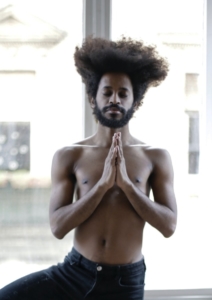
a man stands in a yoga pose next to a windowWhat does it take to be a yoga teacher training student?  Yoga teacher training is a significant undertaking for every student. And one should be aware of the demands and expectations in advance.

Enter the Unknown – Some, if not much, of the content in this program may be new to you.  The content might seem foreign and unfamiliar.  It is a little like traveling to a foreign country where you may not have a grasp the language or the food is different.  The experience of travel is always revealing and can show you a world entirely outside of your known reality.

Experimentation – You can also look at the yoga training as an experiment in which the outcome is not entirely certain, though you have a hunch that it will lead you to a better place.  Yoga practice is unique in that you are both the subject and the object of your study. 

You are not standing there doing tests on something in a petri dish – you are both what’s in the petri dish and the scientist. You are the canvas and the painter.  The program will support you in integrating the pieces of the program into the grand experiment of your life.

You are both what’s in the petri dish and the scientist.

Dedication –  This program is challenging at times. There will be days when you joyfully anticipate class and other days when you may feel challenged and don’t want to go.  Apply yourself to the process to get the most out of it, and know that you will most likely not understand or integrate all of the content. Dedication will help you make the most of this opportunity.

Class Participation – The classroom thrives when people ask questions and fully participate.  Your participation contributes to the welfare of the greater class atmosphere. The program happens over an extended period of time and the cumulative effect of everyone’s participation is quite powerful.

Learn the Craft of Teaching – Being a confident teacher is not a given. As with learning any craft, at first, it can be awkward and unfamiliar.  Inevitable questions arise such as: where do I position myself in the room? how do I demonstrate? how do I find my voice? What happens when many different skill levels show up in the same class?  And many other questions.

It can take months or even years of personal practice and teaching on a regular basis before all the components of teaching come together into one unified whole.  One gradually learns the best places to position themselves in the room, how to bring inflection into their voice, and how to see the postures with great insight.

You will also become masterful at designing classes that meet the unique needs of the students.  You might even accumulate a stash of jokes to let loose at the perfect moment!


Reasons To Do A Yoga Teacher Training

No matter what program you decide to go with (ours or another), a yoga teacher training costs a lot of money, takes a lot of time and asks a lot of you personally. There are many reasons to never take one up. In my view, there are also four reasons to do a yoga teacher training.  And it’s essential if you want to teach.


Reason #1: Adios Sporadic Practice. You’ve read my thoughts about the importance of having a consistent personal practice. I believe that the most potent way to develop one is to do a more involved training.  Maybe you had a real streak in your practice at one time and faintly remember the magic.

I’ve spoken with so many people who think that what they need is to improve on their downward facing dog and develop a positive attitude, when what they really need is a steadfast and safe container in which to be guided into practices that unravel years of accumulated tension and start to re-vision how they see themselves and the world in which they live. 

Start to re-vision how they see themselves
and the world in which they live.

Reason #2: Exponential Momentum. A 60 minutes asana class will only take you so far. The content of classes more or less repeats itself week after week versus a teacher training that builds sequentially and continuously, like a staircase taking you to the top floor balcony where you can see the entire landscape of yoga and your life. 

Dedicated attention from a knowledgeable teacher and a committed circle of peers will exponentially increase your growth. You will receive the support of the class and give support in turn.

Reason #3: Who You Become. One of the biggest benefits of doing a yoga teacher training is who you become. You learn how to manage your mind, eliminate distractions and chart a new path of greater peace and fulfillment.

You don’t just read about these things, you do them for 3.5 months. Yoga teacher training will put yoga at the forefront of your life.  Practicing yoga on a consistent basis for 3.5 months will forever change how you see yourself and how you relate to the world.

Reason #4: Become More Self Reliant. At the end of the program you may discover that you’ve become the source of your own happiness, rather than projecting your sense of worth onto objects or individuals. You’ll probably find that you live in greater accord with what is most important.  Yoga provides a handbook.

Our first yoga teacher training began in 2003.  And since that time I have worked with hundreds of students who come for two basic reasons.  They either want to teach or to deepen their yoga practice.

Be Inquisitive & Expand Your Options

Mainstream yoga focuses on the postures.  However, the potential scope of yoga is far more encompassing. A individual yoga practice is essential to your success as a student and a teacher.

I suggest expanding your options and be open to learning about other yogic modalities. Personally, I feel drawn to personal yoga practice that is rooted in tradition and I offer students the full scope of methodologies.

After some exploration into the deeper, often ignored world of yoga, you might realize that what you really want is to be an ayurvedic practitioner and help people with nutrition and lifestyle rather than teach asana classes. You may find that you really resonate with bhakti yoga (the yoga of devotion), or want to emphasize meditation in your personal practice.  Yoga has so much more to offer beyond the poses. 

There are many possible ways you could ‘do yoga’ in the world.

Find and Learn From a Teacher You Resonate With

You can read my in depth thoughts on the ethos of being a teacher, but I thought I would share some of the most essential aspects here as well.  Not all teachers are equally knowledgeable.  Some teachers will leave a much greater impression than others.

The teacher is there to guide the student on a journey from misperception to seeing themselves and life more fully.  They provide a living, embodied example of yogic principles and are also knowledgeable about the particular methodologies that best suit each student (including asana).  Of course the student is responsible for doing work, the teacher simply provides guidance.

In assessing a teacher see that they have a seasoned understanding of the various methods and also demonstrate a regard for the greater welfare as opposed to just themselves.  Personally, having a teacher who is deeply attuned to the spiritual aspects of yoga is essential.  I consider this to be essential for a student who wants to deepen their yoga practice.

There are lots of yoga trainings in Denver. Each with its own approach and clientele.  Here is a traits of yoga teacher training students that resonate with us. And, in full disclosure, the qualities that don’t.

  • Yoga is not a fad for you. 
  • You want to teach yoga (formally or informally). You know that life can be impossibly overwhelming. People struggle to manage their emotions, feel trapped within their lives, and spiritually depleted.  Yoga helped you to address all of that and it can help others as well.
  • You are easy going, friendly, giving and supportive of one another. You can get on board with a culture of ‘service’ and ‘support’.
  • Value being punctual, and starting class on time out of respect for your peers. You participate in classes and workshops by asking questions and even challenging some of the ideas presented.
  • You have a home practice (in some capacity) and want the most of each class.

Other Traits of Yoga Teacher Training Students…

  • You are willing and able to complete assigned papers and readings.
  • Crave to know yourself more fully and to be inwardly resourced when facing the challenges of life. You stretch into new territory and the discomfort that may go along with that
  • You regard the roots of the yoga tradition. You want classic teachings beyond common cliches such as “this practice is for you”.
  • You have a genuine interest and curiosity about yoga beyond simple asana. Asana is a means to a much greater end that includes stability, equanimity, and spiritual development.

And we have a special place in our hearts for people who…

  • You desire conversations and philosophies with depth. You value wonder and mystery more than “knowing things”.  Our yoga training content is multidimensional.
  • You can be open, honest and self-reflective and are willing to be vulnerable.
  • If I ran into you at  Natural Grocers (Vitamin Cottage), at the Tattered Cover bookstore, we could strike up a nice conversation
  • You are dubious of excessive technology and excessive materialism.
  • A rich supportive community of like-minded seekers is your jam
  • You care about the welfare of the underserved and may want to bring yoga to those communities. You resonate with underground movements that do a lot of good although they don’t get much recognition. 
  • Appreciate that we are a good-hearted and small business. Some administrative details will feel more like a drive through a scenic country road than mainlining on the interstate.
  • You continue to seek balance in your life between your own needs offering help to others.

The following kinds of people are not a good fit:

  • People who are not interested in introspection and just want the yoga teacher training certification
  • Principally want to study yoga as a form of exercise, and no interest in the entire scope of yoga, including spiritual or personal growth
  • Habitually late, and have minimal regard for the collective learning environment
  • Are better suited for a luxury cruise liner than being on a sail boat working side by side with their peers actively contributing to complete the journey together
  • Dependent on technology and could not envision a class, a 10-minute break, or even shavasana without checking their phone
  • Have no interest in personal development.
  • Are exceedingly dependent upon mobile devices. They could not see themselves getting through a lecture, or even a 10-minute break without logging in.

Ever studio has its own culture and set of expectations. These traits of yoga teacher training students offer a clear indication of whether or not our program is a good fit for you. Go with a program that most resonates.

It’s always fascinating to hear how people got into yoga.  For some the process was quite gradual. For others it was a more immediate and affirmative knowing.  “I did not even know it was possible to feel this way!?” For others the road to yoga may have been more rocky and could generally be classified into one of five ways.   Perhaps yoga pulled you through hard times:

  • A Traumatic Event: For some this was a difficult divorce, ending a significant relationship, or an accident. Something has changed their lives forever and they can’t go back to how it was before. Yoga has provided shelter, healing and renewed hope and they want to build on that foundation and perhaps teach others.
  • Burned Out: Whether it’s being a social worker who is continually exposed to the plight of so many, a parent or caregiver (or just an over-giver), many people come to us depleted.  The stress of “trying to keep it all together” has become too much. Maybe they are looking for a career change. They may also come to us in malaise or even depression. They are ready to fill their cup for a change (and not feel guilty about it).
  • Wound Up: Others have come to us with unwanted anxiety, a stressful job,  feeling trapped, questioning if they will ever “be enough”, or generally frustrated with life.  They want to know how to regulate their emotions.
  • Physical Situation: a persistent health issue, sports or dance related injury, body image concerns, or general bodily discomfort. While we won’t promise any miracles and we are here to support one in feeling greater ease and vitality in one’s own skin.
  • Conscious Life Shift: Some have felt lost and without a compass. Others have overcome an addiction, a career change, a recent move or some other big life shift.   The timing seems right and they are ready to mature spiritually and finally do that yoga teacher training that they have been waiting for.

Regardless of the issue, yoga has pulled you through hard times.  Perhaps it even healed you.

If it is, and you’re considering our Denver based yoga training, here’s some of what we’ve learned over the years about who is and is not best suited for the program.