A well designed yoga class flows effortlessly; every instruction or posture builds consecutively.  And at the end of 60 minutes you seemed to have magically found the reset button. How is this possible? A successful class does not happen by accident, an experienced teacher will reference set principles to design and deliver their classes. Here are three keys to teaching yoga.

Three Keys to Teaching Yoga:

Connection

Connection happens when we truly take in, listen too, and or observe whatever is in front of us with genuine wonder, empathy and appreciation. This is true of all genuine human interaction. Relationships occur when we set aside our personal agenda and become more curious and attentive.

As a yoga teacher, we can build connections with students by closely observing students.  On the most surface level we observe their alignment.  We can reflect upon the quality of our instructions and if they translate for students.

Teachers can also be attentive to more subtle signals from students; such as the quality of breath, skin pallor, responsiveness, focus and general quality of energy. 

Experience

Most importantly, a yoga teacher is there to provide an experience for students.  They help them feel integrated and at peace. The sequence of a class, and the cues that a teacher uses, either support or undermine a students ability to have an integrated experience.  

Some teachers get lost in the superficial aspects of a class. They focus on the kind of music they play or how to choreography multiple postures together and miss the bigger picture, often falling back on cliche cues

The point of yoga is to connect to a reservoir of peace inside rather than manufacture a sensational experience.  As a yoga student matures, they become sensitive to their environment. Too much stimulation makes it hard to be mindful and attentive.

One of the most important ways that yoga teachers create an experience is through the cues they give.  Different yoga teacher trainings have different views on how to design a training and instruct a class. Students on our teacher training become fluent in four different kinds of language; each of which creates a specific kind of experience.

Briefly said, some cues direct the students attention to the outer body while others ask them to direct their attention to their inner experience.  Additionally some cues awaken the practitioner’s imagination.  These kinds of instructions are more visceral than they are literal.

Coherent

Practiced deliberately, yoga can be very therapeutic. A skilled practitioner knows how to modify their practice based on their circumstances. The practice they do when tired looks different than the one they do if they feel anxious.

The postures need to build off of each other naturally and based on established principles.  A class should to be integrated rather than disjointed.  When a teacher does not understand the deeper “why” behind each pose, and puts them together haphazardly, the class is less potent.

There are many factors that go into teaching a yoga class. Connection, experience and coherence and three important keys to teach yoga effectively.  A masterful teacher knows how to combine these elements to awaken the higher nature of the students.


Students in Denver Yoga Underground’s yoga teacher training instruct classes outside of the studio. They offer their written reflections on teaching yoga in the community. Here is one such example from a dedicated student who fully embraced the process.

I enjoyed this teaching exercise. I have a background in teaching, so I am already quite comfortable with giving instruction in a group. As a teacher, I sometimes doubt myself or get stressed when I don’t know the content. This came up when I taught my first two yoga classes.

I was very focused on what I was doing, but it wasn’t until the end class that I actually looked up and realized I had students to engage with! After the first few classes, I started to become comfortable with more of the content and the flow of the class, so I was able to start engaging with the students (this also aligned with our YTT classes as we began to discuss the power of observation and different language techniques).

We began to discuss the power of observation and different language

woman with pink hair teaches yoga to a male student

Like anything, by my fifth class, I became more comfortable with what I was doing. I think I still have a lot of areas to work on, for example: reading the students, working on directive language, adding creativity to the class, and practicing safe sequencing. Overall, this exercise was a great way to jump in the deep end of teaching and just start somewhere.

I am often the type of person who needs to make sure everything is aligned before I start to do something, so I appreciated that this exercise forced me to start and begin to learn something from each experience as a teacher. I would like to continue providing practice classes for friends and family so I can continue learning and growing in my teaching skills.

How to integrate these reflections on teaching yoga?

1. Connection (with students and their needs)

2. Experience (teacher as a guide)

3. Fluidity (sequencing and flow)

As I progressed through my practice classes, I believe I was more and more able to incorporate these intentions into my classes. And discover more reflections on teaching yoga. After a few more practices, I started to ease into what it meant to create an experience for the student.

As part of our YTT, students conduct a yoga teacher training exercise to enhance their skills outside of the classroom.  Here is a sample of one students experience.

As a first step, I set my intention for the assignment. This did not come easy, I have a history with wanting to control outcomes. However, I am can draw on my yoga experience and adjust to get the job done regardless of old anxieties. 

The I set the following intentions: provide a safe comfortable place for students to have a wholistic yoga experience, the students students leave class rejuvenated and to inspire student to continue their yoga practice. And to deal more effectively with their own life challenges.

As I assumed the role of yoga teacher, I contended with my own insecurities around control and a lack of trust in other humans. I doubted if they would even show up and I procrastinated doing the assignment for at least 10 days, until I realized that all teacher probably started with some doubt and reservation. 

Once I was able to overcome this low point, I found the yoga teacher training exercise to be a fun and rewarding experience. In particular, I appreciated the chance to work with novice yogis. I remember my initial teachers and it felt good to be able to support others people who just started the journey.  This exercise revealed that I do have love in my heart and desire to grow as a teacher, despite my initial doubt.


How to design a yoga teacher training? A program might have great content but if it is not assembled in an integrated way, you may be in for a rough ride. The design of a programs could be the difference between feeling lost and finding your life’s path.

 It is important that you can assimilate the content you study.  

It takes years of experience to work out the kinks in any training; to integrate theory, practice and pedagogy into a smooth and continuous flow.  Every hour of training is a precious opportunity. You do not want to waste time backtracking or feeling adrift. Imagine a book in which the chapters are in no particular order. Huh?

Imagine a book in which the chapters were in no particular order.

Some programs take the McDonald’s approach and offer many, many homogenized yoga teacher training sessions a year.  It’s a business.  On the upside, the program will be predictable.  They may even have a nice brochure.  On the downside, the presenters may be hemmed in by too many rules and you lose out on the magic of yoga.   It may still be a good experience but not live up to its full potential.

Yoga Training Design

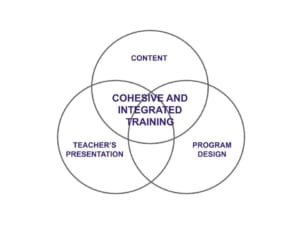
A cohesive and integrated training has three components:


  1. The actual content of the training.  Most interviewing students zoom in on this part.  It’s important and there is more you should know.
  2. The quality of the teacher’s knowledge and their ability to present effectively.
  3. The overall architecture of the program (how individual topics fit into the whole).

Denver Yoga Underground takes all of these components into consideration to deliver a cohesive and integrated training.  The architecture supports the students to gradually assimilate the content, and the teachers deliver the content to the student. This combination supports the student’s growth and are essential parts of how to design a yoga teacher training.


As part of our YTT, students conduct a yoga teacher training exercise to enhance their skills outside of the classroom.  New teachers often experience a lot of anxiety about their new found role and the responsibility it entails. And they may even hesitate to get started.  Once they do get started, they typically find that teaching is not as scary as they’d first presumed.  By the end they feel relieved and event enjoyed their experience.  Here is a sample of one students experience.

As a first step, I set my intention for the assignment. This did not come easy, I have a history with wanting to control outcomes. However, I am can draw on my yoga experience and adjust to get the job done regardless of old anxieties. 

I had the following goals.  Number one, provide a safe comfortable place for students to have a wholistic yoga experience. Number two, the students leave class rejuvenated and to inspire student to continue their yoga practice. And number three, students learn to deal more effectively with their own life challenges.

Students leave class rejuvenated and to inspire student to continue their yoga practice

As I assumed the role of yoga teacher, I contended with my own insecurities around control and a lack of trust in other humans. I doubted if they would even show up and I procrastinated doing the assignment for at least 10 days, until I realized that all teacher probably started with some doubt and reservation. 

Once I was able to overcome this low point, I found teaching my students to be a fun and rewarding experience. In particular, I appreciated the chance to work with novice yogis. I remember my initial teachers and it felt good to be able to support others people who just started the journey.  This yoga teacher training exercise revealed that I do have love in my heart and desire to grow as a teacher, despite my initial doubt.


Over the years, hundreds of students participated in my yoga teacher training. All of them were joined by a common love of yoga and a desire to deepen their yoga practice or teach. The latter can be more daunting. How to be a good yoga teacher.

Be A Dedicated Student

Yoga teacher walks in the classroom

We believe that effective teaching is rooted in being a dedicated student.  Teaching then becomes an organic extension of your committed practice.

To say it another way: if you aren’t a dedicated student you have no chance of becoming a teacher with depth. Your personal practice is the foundation for the house of your teaching.

Of course this same line of thought also pertains to your personal relationship with yoga.  If you practice on a daily basis your mind and body will seamlessly adapt to a more complete version of yourself.  It will happen naturally.

Regularity is the key. Practicing a little each day, or on a regularly scheduled occasion is more effective than “stop and go.” Consistent practice builds momentum over time and eventually takes on a life of its own.

I suggest that students build a dedicated practice and find delight in it also.

Developing a personal yoga practice is a little bit like growing a tree, at first you have to be very diligent to make sure it gets enough water, nutrients and sunlight.  You may also have to put some kind of barrier around it to prevent it from getting stepped on or eaten by insects. Eventually the tree comes into its own, is able to fend for itself, provides shade, fruit and intrinsic beauty.

Being a dedicated yoga student entails both regular practice and natural curiosity.  As you learn and apply new methods and self reflect on their effect, you discover how to shape your experience of life towards one of less fear and towards more joy.

Create a Strong, Deep, Personal Practice.

Dedication is an attitude. Your personal practice is the laboratory in which to apply the attitude. Personal practice will reveal how to be a good yoga teacher.  Like any craft, the more time you spend with it the further you progress.  If you want to master the violin, you need to practice.  If you want to get better at painting, then practice. The same applies to yoga. The only way to receive the benefit is by regular practice.  In order for the practices to work you have to do them.

If you got this far on the site you are probable already sold on yoga.  Maybe you want to take that next quantum step in your practice, maybe even teach, and finally do a YTT.  As you consider your options I’ll share two reasons to do a yoga teacher training.

Reason #1: Find and Live Your Dharma.
Living a dharmic life is a far greater measurement of one’s success at yoga than how long one can hold warrior III.  The word dharma means ‘greater law or order’, it is what gives a particular thing its unique qualities. The dharma of a pumpkin seed is to become a pumpkin, and the dharma of a swallow is to build nests from mud and migrate thousands of miles each year without getting lost.

Because of our capacity for higher reasoning and reflection, human dharma is more dynamic and complicated. Every thought, word, and action can express one’s highest dharma, or not.

women in a yoga training do a twisting posture

Every thought, word, and action can express one’s highest dharma.

Overstimulation, harboring resentment, fantasizing or neglecting one’s responsibilities undermine the ability to live in alignment with higher dharmic virtues.

Yoga helps us to discover and live into our unique dharma.  Yoga allows us to get still and quiet enough to hear the voice of our conscience and make peace with shortcomings. Following the path of dharma gradually leads one down the path of greater fulfillment and meaningful contribution – something everyone wants at their core.

Reason #2: Learn to Teach.  At some point yoga becomes a lifestyle.  It shapes how you eat, who you hang out with, how you think and even how you breath.  Teaching can be a natural extension of your values and your personal relationship to yoga.  It feels good to live congruently.

I consider it to be a blessing for both you and the students.

Many people are searching for some way out of their current working life and feel the need to make a greater contribution. Yoga could potentially be that outlet.  I suggest easing your way into the transition to becoming a full time yoga teacher.  What ever path you choose, there are at least two reasons to do a yoga teacher training.