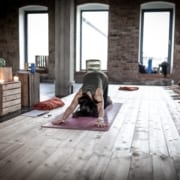
woman in dog pose in a yoga studio


“Why is peace unprioritized?”

I shared this question with my current teacher training students over the weekend.  They looked equally appreciative and puzzled.

You would think that the desire to live in harmony would be greater than the urge for affliction.  Yet somehow that does not appear to be the case.

Like many noble pursuits, peace can easily be dismissed as fanciful, a hangover from the counterculture movement, or even a sign of weakness. Peace is not in keeping with the status quo, a tide of stimulation usurp its place.

“Why is that?”

Years ago, when I first met Baba Hari Dass, someone asked him “how to develop personal discipline?”

His response:

“Climbing is hard, slipping is easy.” 


The words still ring true decades later and epitomize why peace is not the priority. It takes deliberate effort to develop positive qualities and the temptation to deviate can be strong.

The impulse to be impatient or disregard the needs of the whole may come more habitually and with greater urgency.  It takes far more energy and thoughtful consideration to create a building than it does to destroy it.

In short, cultivating peace requires dedicated self-reflection and effort – to swim against the current shortcomings and climb towards a noble pursuit. And it can be often far more convenient to choose otherwise.

There are many approaches to meditation. Finding the optimal technique is a bit like searching for a treasure in a darkened room.  The treasure holds the promise of greater inner-freedom however, and you’ll sift through less idyllic objects as you blindly sweep the floor with outstretched hands.

Fortunately, your search for the best meditation method can be distilled down to one of three primary categories. These categories range from the most passive to the most elaborate:

  1. Mindfulness.  In simple terms, mindfulness is the act of being fully present to whatever task, experience, or thought you happen to be having. This is one of the most recognized techniques because of its obvious universal application and ‘non-metaphysical’ demure.
  1. Self Reflection. Other techniques ask you to focus on a particular construct such as the fabled utterance “Aham-Brahmasmi” or “I am divinity itself.”  While the mantra itself possesses some potency, the real power of this method comes from the necessary self-reflection and the conviction that life is composed of more than ego-perspective.
  1. Kriya.  Kriya means a ‘method’ or ‘procedure’.  These procedures systematically blend various forms of imagery, colors, sounds, and associations to curate a particularly energetic and psychological reality in the practitioner.

    Unlike the universal approach of mindfulness, kriyas invoke a specific experience to suit the exact needs of the aspirant based on their current life circumstances and how they wish to evolve.  These practices, derived from tantra, are much more dynamic.

    These practices, derived from tantra, are much more dynamic.


    One may presume that kriyas entail an element of “imagination” or “pretending” to tap into an alternate reality.  The more that I’ve studied and practiced yoga, the more I’ve come to see and appreciate it’s metaphysical perspective.

    The Universe has more dimensions than length, height, and width and the vast, vast, vast majority of it exists outside of the limited field of our senses. We only see .03 percent of that available light spectrum that emanates from the sun, as an example.  I’ve come to recognize kriya as a porthole into a pre-existing plane of existence, outside of conditioned existence.

Meditation to Increase Shakti is a simple example of this kind of kriya. It also is the consummate practice for our May Meditation Series. Shakti means power or force, she is the inherent and presiding force of manifestation itself.  Without Shakti, there would be no life.

Kriya then is the systematic method by which one can enter into the awareness of this presiding force. It invokes the living presence and power of Shakti and most sublime attributes.  With continued practice, the meditator gradually assumes these qualities.  

Different forms of meditation will breed and awaken a different visceral reality.

Just as every seed contains a unique kind of plant in it – be it an oak tree or a rose bush – different forms of meditation will breed and awaken a different visceral reality inside of you.  Despite their aura of universal spirituality, different meditations will awaken a unique attribute of your soul and psyche.

When choosing an optimal meditation method, the most important thing is to get started.  Reflect on which of these three is most appeals, seek guidance, and most importantly just get started. Any of these approaches will help you to see yourself more clearly and help you discern its unique value and attributes.

man practices meditation

Asana, pranayama, meditation, and other Tantric-Yoga methods remold your psyche from a limited understanding (avidya) to greater Self-understanding. In short, they maximize joy and minimize suffering.

To become proficient at blending these Tantric-Yoga methods requires ongoing practice, refinement, and moments of inner realization.  It’s an extraordinary journey that gradually begins to touch upon every aspect of one’s life.

Tantra is somewhat unique on the horizon of spiritual methodologies; it prescribes practices to suit the needs of the individual. Each of us is unique (and similar in ways) and our approach to yoga ought to reflect our particular needs.  

Our approach to yoga ought to reflect our unique needs.  

To accommodate the needs of the individual, Tantric-Yoga methods can be very complex and nuanced. It takes time, and some trial and error, to learn how to synergistically blend asana, pranayama, mantra, and meditation techniques.  Of course, an accomplished teacher also helps.  

Done well, the result of these interwoven practices is far greater than the sum of their parts.  Asana and pranayama practice, implemented prior to meditation, will powerfully enhance meditation exponentially. 

They support one another in an interwoven and radiant tapestry. These interconnected practices, done in support of higher realization, is one of the very definitions of “tantra”.  In many ways, the journey through Tantric-Yoga is a journey through the interconnected threads of practice.

While the variety of practices may seem disparate, there is a central thread that underscores them all; that thread is prana.  Prana is the life-force of the creation, the very force of transformation itself; our quest for greater peace and self-actualization hinges on this critical ingredient.

 There is a central thread that underscores them all;
that thread is prana.

All of the techniques interface with prana specifically.  In many ways, prana is the primary teacher that not only leads us to greater levels of self-mastery but also guides us towards the innermost teacher within us all, the Self or the Soul.

Tantric-yoga methods support us to contact this Self and in turn, the Self aids you to learn and apply the forces of asana, pranayama, and meditation optimally.  Over time, one recognizes the pranic-force within these methods and thus the cycle of continued growth carries on. One becomes more adept in their life and access Spirit more readily.

Full confession, I have had seasonal allergies for years; itchy eyes, stuffy nose, and sneezing attacks, the full deal. As a yogi – someone who places a premium on self healing – it was a point of consternation.

Historically, I’d adjusted my yoga asana practice (to include more inversions) to address it, but had minimal results. Natural supplements did not do the trick either.

This season, and last season, I decided to dedicate myself to a path of self healing and implemented simple ayurvedic remedies for allergies. Ayurveda is the ancient healing science of India that grew up side by side with yoga.

Ayurveda is the ancient healing science of India
That grew up side by side with yoga. 

According to ayurveda, allergies (along with many other ailments) stem from accumulated toxic build-up, called ama, as a result of poor digestion. The treatment is quite simple; reduce ama.  This can be done through a deeper cleansing process (called shat karma) or, more immediately, through diet.

Here are the basic guidelines I follow.  I find it easier to negate certain foods and eat what remains, which will inherently be nourishing.  Ayurveda has a lot to say about diet but here are the basics:

  • Typically it helps to have a 4-6 week dietary reboot before the actual allergy season hits.  “Prevention is Supreme” as they say in ayurveda. All the same, these simple changes will make a change, it just may take a little longer to reverse the cycle.
  • Remove sugar, dairy, gluten, caffeine, and alcohol
  • Maybe start by reducing one or two and phase others in once you see the value of the preceding changes
  • Start by removing sugar and dairy (then gluten)
  • Additionally, I find it helpful to brush my teeth immediately after eating to reduce any cravings.  You can also integrate turmeric shoots for their anti-allergy properties and for general anti-inflammatory properties.  The bitter-astringent taste also reduces cravings.
  • Dandelion greens are good anti-allergens as well, which you can probably get from your backyard.

”Prevention is Supreme.”

Changing one’s diet can be a tough pill to swallow but inevitably turns out to be worth the sacrifice.  In this case, the payoff was increased energy, eliminating allergies, and a sense of empowerment – I can heal myself through my own choices and actions.

Of course, a dedicated yoga practice will also help the cause.  Consider taking a class (online).  I happen to be offering a meditation series that you are invited to attend.

Details:

  • Wednesday and Friday, 7:30-8:10am
  • Zoom link provided upon registration
  • = Donation Based =

– REGISTER HERE

Visual representation of repetition in meditation

First, a word of thanks to all of those who extended their good wishes, food, and prayers after I broke my leg some three weeks ago.  I’m happy to say that the force of healing is alive within me and I make noticeable progress each day. In part, I attribute this healing to repetition in meditation.

As an offshoot of that healing process, I started to offer a free, online meditation course on Wednesday and Friday mornings, 7:30-8:10am. The class consists of a brief asana practice, opening mantra, followed by pranayama, then meditation proper, and a closing mantra. Admittedly, it starts abruptly to ensure we cover these synergistic practices. We don’t discuss theory so much as, well, just get started.

So, I want to give a little context and share one simple idea underlying our practice.  That is simply this, “repetition in meditation”. Repetition is integral to any discipline; whether it be learning the violin, fostering a loving relationship, or advancing spiritual growth. The journey of 1,000 begins with the first step.  And then the next step. And then the next step…. repetition.

There is a fairly well-known expression within meditation circles:

“Better to dig one deep well than many shallow holes.”

For this reason, the repetition in meditation technique I present remains the same for the remainder of the series. My hope is that we get enough of a footing on the method that it becomes a part of us – to give it a fair chance to positively shape the way we view ourselves and our world.

Adopting a single technique for forty days is a common benchmark to get acquainted with a technique.  After those forty days of repeated practice, you can adequately assess if you wish to continue, or not.  There is an overwhelming chance that you will see the benefit and want to continue, you will have seen the value of repetition in meditation.

At the same time, we live in a culture obsessed with variety, innovation, and distraction (largely for commercial purposes). Methodical repetition is antithetical to the pace of modern life (though that seems to be on hold for the moment). However, to develop mastery, or better yet, to develop mastery of your mind, body, and character it takes more than one try. With persistent effort, you will discover the benefit.  The meditation class is here to support you to develop that skill. Of course, I’d encourage you to practice outside of class as well.

“The beginner has many options, the master very few.”

The beginner has many options, the master very few.  As you develop your meditation practice, I invite you to embrace repetition.  Through repetition in meditation, gradually clear away the dust and grime that obscures the inner-mirror. This inner-mirror aids you to see yourself more clearly, to dismantle fear and anxiety and reflect greater peace and joy back upon you.  But it doesn’t all happen by itself, it requires repetition.

Dates & Times:

  • Present through May 1st, 2020
    (May extend depending on interest)
  • Wednesdays and Fridays, 7:30-8:10am.
  • Online Zoom entry-link provided with registration

= Free of Charge =

ADDITIONAL DETAILS HERE

Trust this finds you safe and perhaps even able to adapt to current circumstances.  In either case, it’s times like these that force us to reframe our assumptions of “normal”,  reconsider where we derive security, and reflect on our yoga practice.

Personally, meditation has always been my go-to safe-space.  I can practice at any time, regardless of outer circumstances, and find refuge. It is a friend in times of plenty and in times of need.

On March 23rd, on the eve of the stay at home order, I slammed into the concrete in a bike crash and broke my left femur bone.  Assessing the damage, getting to the hospital, going into surgery… it all felt so surreal and beyond my control. This is not happening to me?  

Then the emotions came.  At first, I held the warrior’s edge to deal with the pain and work with the medical teams.   Which gave way to grief once the initial trauma subsided and I was alone in my hospital bed at 3am.  Slow warm tears and a sense of loss.

It’s been a journey of reckoning. Throughout that journey, meditation has been my throughline, the port in the storm, my guiding compass and light. Bedridden, through the powers of meditation, I began to put my fragile self back together and ignite the flame of healing.

Adversity brings out many things in people, and in my case, it’s inspired me to share what I know and love best with you.  Meditation.  Current events make this offer even more pertinent. I hope we can all find a way to give our gifts in a time of need.

All are freely welcome. Come and reflect on our yoga practice.

Hatha Yoga Meditation Class Format:
The 35-minute class will look like this:

  • Introduction
  • Candle lighting and mantra invocation (Mahamritunjaya mantra for personal and collective healing) 
  • Dedicated pranayama practice
  • Guided meditation
  • Closing mantra (Shantipath for peace)

Taught from the serenity of my ‘yoga basement’ this class will emphasize direct practice of tantric hatha yoga meditation, more so than theory or explanation.  I will provide supplemental links and resources so you can continue the practice outside of our sessions.

Yours in Peace,

Signature of the lead teacher for the Denver Yoga Underground.


Integrated yoga Postures

Integrated yoga postures do not happen on their own.  An astute yoga teacher goes beyond a route understanding of poses or scripped sequences.  More than likely, they understand anatomy and physiology and how all the components of the body fit together.

This allows them to intelligently sequence their yoga classes such that one posture seamlessly unfolds into and complements the next.  As a metaphor, it is a little like seeing the underlying patterns that solve a Rubik’s Cube. The novice will hopelessly turn the thing over and over, daunted by the interwoven puzzle.

“Oh, I think I got it!” Is soon followed by by “C^@&,
I messed up the other side!”

As any beginning yoga student can attest, the poses initially appear unattainable.  However, with practice, one learns how to lovingly work with the inherent structure of the body and encourage it to gracefully open to create integrated yoga postures.  At first, the green side of the cube may start to emerge. Eventually, the other sides of the start to open.  Red, yellow, blue, white and orange begin to gradually follow suit.

To skillfully solve the puzzle it helps to understand how all the colors relate to one another, to learn what postures feed into other postures. This process is a journey of trial, error and discovery.  With time, one learns how to create integrated yoga postures that are much greater than the sum of their parts. 

Sometimes you need a more blue practice that features forward folds, other times you need a fiery red practice that emphasizes back bends.  Or perhaps you need a yellow practice to brighten your day. Some understanding of anatomy will give you the tools to work with the body and safely approach more and more advanced postures that suit your particular needs, whatever color that may be.

“This is the beauty of yoga practice…”

In part, this is the beauty of yoga practice. It is an ongoing process of self discovery.  One gets to explore how the different parts of their body are interwoven with one another and how to bring these components together into one seamless expression. All the colors align to foster ultimate wellbeing.  

This is my final letter of 2019 to share with you a commitment for 2020. I continue to expand the reach of my offerings and want to make yoga training available for everyone. As you know, yoga is beneficial in so many ways and it only seems reasonable to share it generously.

Yogis practicing yoga nidra

Yoga, as a traditional practice, is the skillful and earnest exploration of the personal and transpersonal human experience. Yoga as a practice of personal discipline and self-inquiry is and will always be “free” to explore, and the teachings are readily available in publications and on the internet. All of us long for peace on the deepest level.

And while weekend immersions and retreats are powerfully transformative,
not everyone can access or afford it.

I’m very excited to announce that my first two primary Colorado offerings in 2020 will be offered on either be donation or Pay What You Can basis.  I will teach my yoga nidra training collaboration with Axis Yoga/The Yoga Underground, and Erik Vienneau the founder of Awake, both of whom share a commitment to accessibility.  I list the events here in short form:

  • Pay-What-You-Can Yoga Nidra Immersion at Axis Yoga/The Yoga Underground Jan 31-Feb 2nd
  • Awake Meditation 1-Day Retreat, by donation, at The Gathering in Evergreen Feb 9th

Please spread the word, particularly to those typically may not be able to afford more advanced training.  There is limited at these events and early registration is recommended.

For complete details on these and many other offerings please visit my website.

I hope this holiday season brings you heart-felt connections with loved ones. And we can share in a desire to make yoga training available to everyone.

– Jeremy Wolf

How Do I Develop a Home Practice?

In an age of unprecedented amounts of distractions, it’s no wonder that so many people struggle with having a regular home practice.

How to start?  Ideally you receive instruction from a qualified teacher who gives a specific method and guidance based on your particular psycho-physiological constitution. Pranayama (breathing practices) is a vital component of getting the mind to be less rebellious and able to focus.  The fellowship of fellow practitioners (satsang) is also very supportive.

Though less ideal, people also turn to meditation apps such as Headspace, and Rod Stryker’s Sanctuary for instruction.  There are plenty of online resources for asana practice as well. Start with the first step. Postponing, or just thinking about a regular practice will not have the same effect.  

A regular home meditation and/or asana practice marks the transition from being a yoga student to becoming a yogi. A yogi is someone who recognizes their limitations and has taken ownership of their evolution. They see the value of regular practice and make it a priority.

Doing 10-15 minutes of meditation a day is an excellent start. Practicing asana for 20 minutes is also beneficial.  Ideally one can dedicate a half hour to an hour on a daily basis. It does not have to be all or nothing.


The dust and confetti of the holiday season has finally settled and perhaps you have gotten some traction on your intention for 2019.  Mine is/was to give up sugar for 40 days. However, the path of living into a new lifestyle is rarely a straight line. More often than not, affecting life changes is a much more messy process.

The seductive voice of comfort and convenience can creep in and derail our deeper knowing and higher aspirations.  In the words of the famed warrior, Arjuna, in the infamous yogic text the Bhagavad Gita:

The mind is very restless, turbulent, strong and obstinate, O Krishna.
It appears to me that it is more difficult to control than the wind.

So how do we get a grip on our detracting desires and live into our higher aspirations? And more specifically, how can yoga help us with that?

On a physical level, yoga postures (and meditation) have been scientifically demonstrated to re-pattern the neural structures and pathways in the brain as well as correlate structures in the heart and gut, each of which has a unique intelligence.  

Yoga can unlock stuck psychological patterning on a neurological level – something like untangling a knotted ball of twine and rolling it back up again, neat and organized.

There are many stories of yogis who willfully embraced extreme disciplines to arrive at a transcendental boon.  Parvati ate nothing but leaves for years to win the hand of Lord Shiva, Arjuna vowed to avenge his fallen son before sundown or take his own life, Gandhi fasted and performed other acts of austerity to strengthen his resolve for an independent India.

Maybe you are not out to marry a god, make a mortal vow, or to topple an empire but you can move towards your higher-self.  This requires a willingness to trade in something of lower value for something of higher, yet unknown value.

Here are four simple suggestions to help you to reassemble any bygone resolutions for the new year or simple take up a new direction for your life.    

Choose Your Battles
What’s the one thing that you can embrace, or let go of, that is going to give you the greatest return on your effort?  If you try to make too many changes on many fronts you are far less likely to succeed. For me, that one thing was giving up sugar.  In part the benefit has come from not eating a toxic substance but the other part is that it has forced me to eat far less processed food.  Which in turn has led to much more emotional and energetic stability.

Practice skillful-means.  Be selective about what changes you want to make and find one simple act that can foster those changes.  Maybe you want to take the task in parts.

Make Incremental Changes
People can cook up an overinflated version of who they think they should be.  Book stores and libraries line their shelves with texts espousing the virtues of being a ‘Bad Ass’. And the latest seminar promises it all: wealth and glory.  Grandeur can often be a toxic mimic of our true place in the world and within ourselves. Perhaps authenticity is more powerful and real than boundless desire.

Sustainable change is much more gradual than sensational.  We see this in nature, the sun moves just slowly enough to be imperceptible; yet we know it is moving by watching the shadows slowly bend in its light.  All life lives in relationship to the sun.

On a psychological level the mind has many self protective mechanisms, many of them unconscious, that easily rebel when they perceive the unknown coming down the road.  Part of us wants to change while other parts stand ready to put on the breaks.  Transformation is less about conquest and more about patience and consistent effort.

Get Support
Another part of the great American mythology says that we must do everything by ourselves, to triumphantly brave adversity and arrive at our personal promised-land.  In fact, you are far more likely to be successful with the support of the tribe. Many people are not fully aware of the degree to which they are isolated and lack the perspective of outside eyes.

Is there someone who is close to you that you can confide in, and start to bridge your intention from your head and into the world.  Even social media could be a possible outlet for getting some collective support and accountability. Or better yet, get the support of a dedicated group of peers.  This could be colleagues at work or some circle that shares the values that you are trying to create for yourself.

Practice Yoga
Yoga has been proven, time and time again, to move the needle away from self-sabotaging behaviors and replace them with more positive ones.  Think of it as having a magic power. And if you water the seeds of this magic power regularly, it will grow. Whether we are trying to sleep better or give up drinking, yoga can help, particularly when given guidance from an expert teacher.

Of these four recommendations I would recommend the last one, practicing yoga, the most.  Followed by getting support. Practicing yoga in a committed circle of peers, under the guidance of a advanced teacher, will nurture your intentions in ways that you are currently not present to.  What’s more it will safely open the door into new realms of possibility.

Much of the year is yet to come and I invite you to gradually foster a more joyful version of yourself for your own benefit and for the benefit of those who surround you.