I’ve been at this yoga project for a while, the river of yoga practice has ebbed and flowed its way over 34 years of life-terrain, touching gain, loss, heartache, moments of insight, flesh & blood, and clear stillness; meandering towards a greater ocean, somewhere on the other side of present mountains.

The practice evolves with time; as ecology evolves; as culture evolves; as insight matures; and our role changes. Thankfully, there are many methods to support us in these changes.  Still, the actual experience of yoga itself is timeless. “Yoga is as old as human heart” as Babji would say.

The practices are a means to a greater end, that sounds something like: deep harmony, right-relationship, and even revelation. Over the decades, here have been times when I’ve mistaken means for ends, clung to rout-methodology and forgot the larger purpose or spirited-connection to yoga.

Looking back, over the decades, and the many yoga teacher trainings, these barren moments seem strangely necessary. Then come the cool rains of grace, perhaps at an unexpected moment, that revive the deeper spirit of why we practice at all.

Back in the early 90’s, when I first went to yoga classes, the practice was closely associated with “discipline.” People talked about “discipline” the same way we talk about “inclusion” or “trauma sensitivity” now. Long before prevalent teacher training, the yoga of discipline was in the air of practice.

Discipline is an essential aspect of what the yogis call “Tapas.” Tapas are the creative friction that arises when going (a bit) against the grain of impulses; it gives rise to generative heat that opens new possibilities and develops one’s character.

Tending to the fire of transformation is tapas.  

circle of tapas, sustained effort

However, some habits seem quite stubborn and we may like the idea of “I will meditate every morning” but it remains elusive. I have my own fantasized version of a disciplined-self that does not parallel the reality of my behaviors. Sound familiar?

Here is a rewarding middle option. Practice “micro-disciplines” in the moment. Notice moments in your day when you can choose your higher virtue. Sacrifice a bit of comfort in the moment and nudge your way into a more fulfilling direction one small and simple choice at a time. I invite you to experiment with this in your day to day decisions.

Here’s a fun question…. What is your go-to yogic teachings “off the mat”?  

A few come to mind: “patience”, “acceptance”–that’s a big one–or “giving of oneself”, all of which read nice on paper and can be much more difficult to put into practice.

Genuine yoga practice is something we live into rather than something to “do.”  

Layer by layer yoga reveals hidden and not so hidden tendencies and invites to apply the principles of “patience”, “acceptance” and so forth to living circumstances.

Overtime, leaving no stone is left unturned.

Baba Hari Dass used to say “climbing is hard and slipping is easy.”  It takes a bit of determination to live into one’s higher virtues, to apply yogic teachings in daily life.  But the alternative also comes with its price.

So, what is your go-to yoga practice off the mat?

Perhaps you’ve heard Patañjali’s quintessential definition of yoga? I captures the essence of yoga.

It’s quite simple, and simultaneously vast; two signature features of wisdom.
 

“Yoga is the stilling of all thought.”
 

This definition probably conjures more questions than answers and invites us to reconsider our mental space…. what are thoughts anyway?

Patañjali goes on to assert that the mind occupies the surface of our being, vailing our essential nature. 

Who would we be in the absence of  thoughts and opinions about self and “others”?
How does one still the mind?
And why would we want to do such a thing anyway? 

More questions….

On a practical level, I invite us to consider the mutable nature of thought, how it can seem so dense, habituated and convincing at times and simultaneously amorphous, shifting and changing in every moment.

Sometimes the mental story is caked with adversity and sometimes it is not.  Yoga is the process by which we can come to terms with our particular narratives, create a bit of space, and draw closer to our essential nature.

Have you ever felt stuck in your own thinking? Unable to see past assumptions? Out of touch with the yoga of insight and pretty convinced you have the answer, and yet a small voice might remind you that there are limitless perspectives?

I suspect this is true for most of us.

In many ways, yoga practice breaks us out of the trance of our own thinking and invites us into a deeper view; to see beyond our particular self-interest and rest into something we might call wisdom.

Sounds kind of nice, right?
“How” you might ask? 

The answer is not very glamorous.  

As my root teacher Baba Hari Dass would often say, “Regular practice.”  Most find this challenging, but is nonetheless essential.  

Perhaps regular practice could look like 10 conscious breaths every time you park your vehicle, daily morning meditation, a class you can consistently go to. Swapping 10 minutes of scrolling for 10 minutes of legs up the wall. Or  a structured program could be helpful.

What may seem like an insurmountable mountain of resistance may just be a fleeting and wispy cloud through the sky of the mind, vailing the sun on the other side. The sun is perennially there, though ingrained assumptions could be blocking its light.

Yours In the Spirit & Service of Yoga,
Derik E.

In many respects, yoga teacher training is a journey into the unknown.  People may anticipate a training for years and contemplate what it will be like. They consider how it will enrich their practice and what it would be like to teach yoga.  Students anticipate how their body will become more open, or the benefit of added mental serenity. These are the easy and obvious things to imagine.  People are less likely to consider the additional yoga teacher training assignments that accompany a program. And how it will impact their life outside of the studio space.

Outside study often looks like: reading assignments, written reflections (papers), lifestyle changes, student teaching exercises, or to develop a daily meditation practice.  This list of activities may simultaneously look inviting and intimidating.

One one level, we appreciate that each of these activities will help us to embody yoga.  On another level, it might bring up insecurity about how or when you will be able to complete the exercises.  In part, this is why people sign up for more advanced yoga training, they want to overcome resistance, be accountable, receive guidance and forge a new destiny.

“They want to overcome resistance, be accountable, receive guidance and forge a new destiny.”

Additional yoga teacher training assignments bridge the gap between formal study in the studio space and daily life.  Yoga is a universal method to cultivate inner peace and to achieve greater outer harmony.  All life circumstances provide an opportunity to practice yoga, not just formal time on the mat

Yoga teacher training comes in a variety of formats.  Some are presented as concentrated, residential, month long formats. It will be easier to complete assignments in this format, there will be fewer distractions. Others (like DYU’s program) are engineered for a typical working person with a couple of kids.Yoga training often generates a natural passion to live a more conscious life and people embrace additional yoga teacher training assignments as part of that process. I invite you to embrace all that a program has to offer and also recognize that there will be additional demands on your time beyond formal classroom content.  Ultimately, this is a core reason to sign up for yoga training.

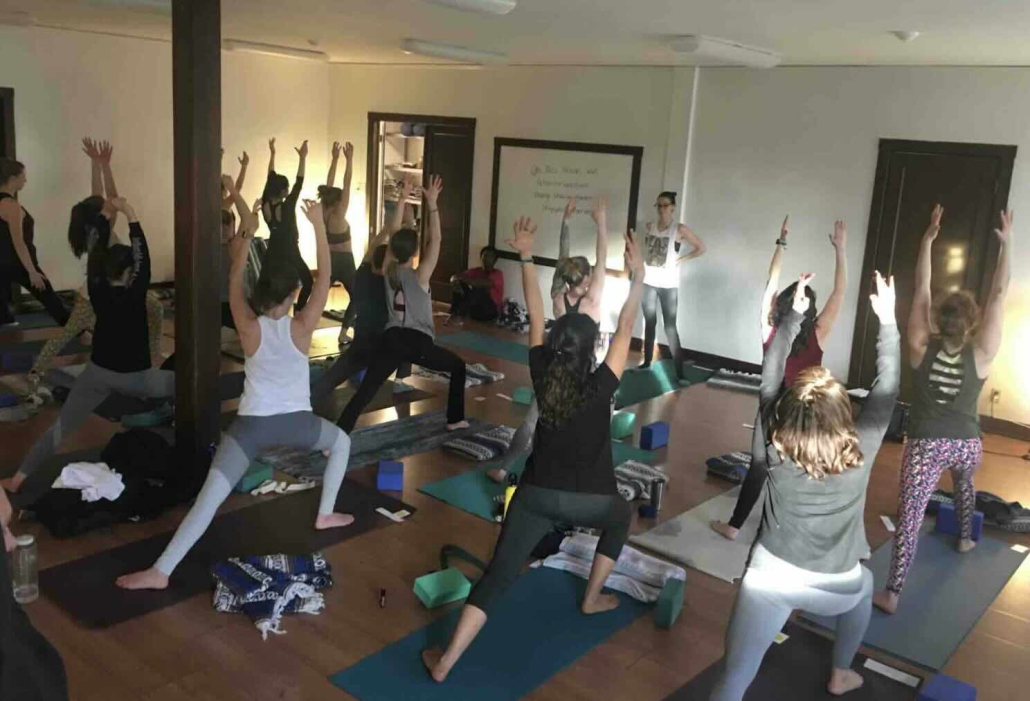
As part of Denver Yoga Underground’s yoga teacher training, students are required to attend five classes outside of the formal program.  They then submit a written reflection on their experience.  Here is an example of the process, this student learned to become a better yoga teacher through observation.

In total, I attended three Vinyasa yoga classes, one Iyengar yoga class and a Hot Power Yoga class. Overall, I learned that a clear theme for a class is essential as is the teacher’s use of language.

For the purposes of this exercise, I took a wide range of classes including a “goat yoga” class. The goats freely interacted with students during the class. The teacher renamed poses like downward goat instead of downward dog, which complemented the theme. The pace of the class was slower to allow time for a goat to crawl onto or off of a person. The class was silly and fun however I would not go there to learn about the deeper meaning of yoga.  It felt more like a visit to the county fair with some “yoga poses” mixed in. It was more amusing than enlightening.

It felt more like a visit to the county fair
with some “yoga poses” mixed in.

The goat class had a clear intent, to generate a novel experience.  Other classes presented an odd mixture of unrelated intentions. I most appreciated classes that stayed within the parameters of their stated theme.  The Iyengar yoga class I attended had a clearly defined theme. This was the first time I participated in a class deconstructed a single pose with such detail. As a prospective yoga teacher, I was reminded of the many ways people can hone in on their craft.

The theme of a class, and the quality of instruction can either make one feel grounded or disoriented.  Yoga is a potent medicine. I can even create a new destiny.   Most of the time the result is positive however if the medicine is used in the wrong way, it can make someone anxious or imbalanced.

Yoga is a potent medicine.

Through this exercise, I learned the importance of language as a yoga teacher, how to pace a class, and why it is essential to have a clear theme. Overall, I learned to be a better yoga teacher through observation.

woman in dog pose in a yoga studio


“Why is peace unprioritized?”

I shared this question with my current teacher training students over the weekend.  They looked equally appreciative and puzzled.

You would think that the desire to live in harmony would be greater than the urge for affliction.  Yet somehow that does not appear to be the case.

Like many noble pursuits, peace can easily be dismissed as fanciful, a hangover from the counterculture movement, or even a sign of weakness. Peace is not in keeping with the status quo, a tide of stimulation usurp its place.

“Why is that?”

Years ago, when I first met Baba Hari Dass, someone asked him “how to develop personal discipline?”

His response:

“Climbing is hard, slipping is easy.” 


The words still ring true decades later and epitomize why peace is not the priority. It takes deliberate effort to develop positive qualities and the temptation to deviate can be strong.

The impulse to be impatient or disregard the needs of the whole may come more habitually and with greater urgency.  It takes far more energy and thoughtful consideration to create a building than it does to destroy it.

In short, cultivating peace requires dedicated self-reflection and effort – to swim against the current shortcomings and climb towards a noble pursuit. And it can be often far more convenient to choose otherwise.

There are many approaches to meditation. Finding the optimal technique is a bit like searching for a treasure in a darkened room.  The treasure holds the promise of greater inner-freedom however, and you’ll sift through less idyllic objects as you blindly sweep the floor with outstretched hands.

Fortunately, your search for the best meditation method can be distilled down to one of three primary categories. These categories range from the most passive to the most elaborate:

  1. Mindfulness.  In simple terms, mindfulness is the act of being fully present to whatever task, experience, or thought you happen to be having. This is one of the most recognized techniques because of its obvious universal application and ‘non-metaphysical’ demure.
  1. Self Reflection. Other techniques ask you to focus on a particular construct such as the fabled utterance “Aham-Brahmasmi” or “I am divinity itself.”  While the mantra itself possesses some potency, the real power of this method comes from the necessary self-reflection and the conviction that life is composed of more than ego-perspective.
  1. Kriya.  Kriya means a ‘method’ or ‘procedure’.  These procedures systematically blend various forms of imagery, colors, sounds, and associations to curate a particularly energetic and psychological reality in the practitioner.

    Unlike the universal approach of mindfulness, kriyas invoke a specific experience to suit the exact needs of the aspirant based on their current life circumstances and how they wish to evolve.  These practices, derived from tantra, are much more dynamic.

    These practices, derived from tantra, are much more dynamic.


    One may presume that kriyas entail an element of “imagination” or “pretending” to tap into an alternate reality.  The more that I’ve studied and practiced yoga, the more I’ve come to see and appreciate it’s metaphysical perspective.

    The Universe has more dimensions than length, height, and width and the vast, vast, vast majority of it exists outside of the limited field of our senses. We only see .03 percent of that available light spectrum that emanates from the sun, as an example.  I’ve come to recognize kriya as a porthole into a pre-existing plane of existence, outside of conditioned existence.

Meditation to Increase Shakti is a simple example of this kind of kriya. It also is the consummate practice for our May Meditation Series. Shakti means power or force, she is the inherent and presiding force of manifestation itself.  Without Shakti, there would be no life.

Kriya then is the systematic method by which one can enter into the awareness of this presiding force. It invokes the living presence and power of Shakti and most sublime attributes.  With continued practice, the meditator gradually assumes these qualities.  

Different forms of meditation will breed and awaken a different visceral reality.

Just as every seed contains a unique kind of plant in it – be it an oak tree or a rose bush – different forms of meditation will breed and awaken a different visceral reality inside of you.  Despite their aura of universal spirituality, different meditations will awaken a unique attribute of your soul and psyche.

When choosing an optimal meditation method, the most important thing is to get started.  Reflect on which of these three is most appeals, seek guidance, and most importantly just get started. Any of these approaches will help you to see yourself more clearly and help you discern its unique value and attributes.

man practices meditation

Asana, pranayama, meditation, and other Tantric-Yoga methods remold your psyche from a limited understanding (avidya) to greater Self-understanding. In short, they maximize joy and minimize suffering.

To become proficient at blending these Tantric-Yoga methods requires ongoing practice, refinement, and moments of inner realization.  It’s an extraordinary journey that gradually begins to touch upon every aspect of one’s life.

Tantra is somewhat unique on the horizon of spiritual methodologies; it prescribes practices to suit the needs of the individual. Each of us is unique (and similar in ways) and our approach to yoga ought to reflect our particular needs.  

Our approach to yoga ought to reflect our unique needs.  

To accommodate the needs of the individual, Tantric-Yoga methods can be very complex and nuanced. It takes time, and some trial and error, to learn how to synergistically blend asana, pranayama, mantra, and meditation techniques.  Of course, an accomplished teacher also helps.  

Done well, the result of these interwoven practices is far greater than the sum of their parts.  Asana and pranayama practice, implemented prior to meditation, will powerfully enhance meditation exponentially. 

They support one another in an interwoven and radiant tapestry. These interconnected practices, done in support of higher realization, is one of the very definitions of “tantra”.  In many ways, the journey through Tantric-Yoga is a journey through the interconnected threads of practice.

While the variety of practices may seem disparate, there is a central thread that underscores them all; that thread is prana.  Prana is the life-force of the creation, the very force of transformation itself; our quest for greater peace and self-actualization hinges on this critical ingredient.

 There is a central thread that underscores them all;
that thread is prana.

All of the techniques interface with prana specifically.  In many ways, prana is the primary teacher that not only leads us to greater levels of self-mastery but also guides us towards the innermost teacher within us all, the Self or the Soul.

Tantric-yoga methods support us to contact this Self and in turn, the Self aids you to learn and apply the forces of asana, pranayama, and meditation optimally.  Over time, one recognizes the pranic-force within these methods and thus the cycle of continued growth carries on. One becomes more adept in their life and access Spirit more readily.